
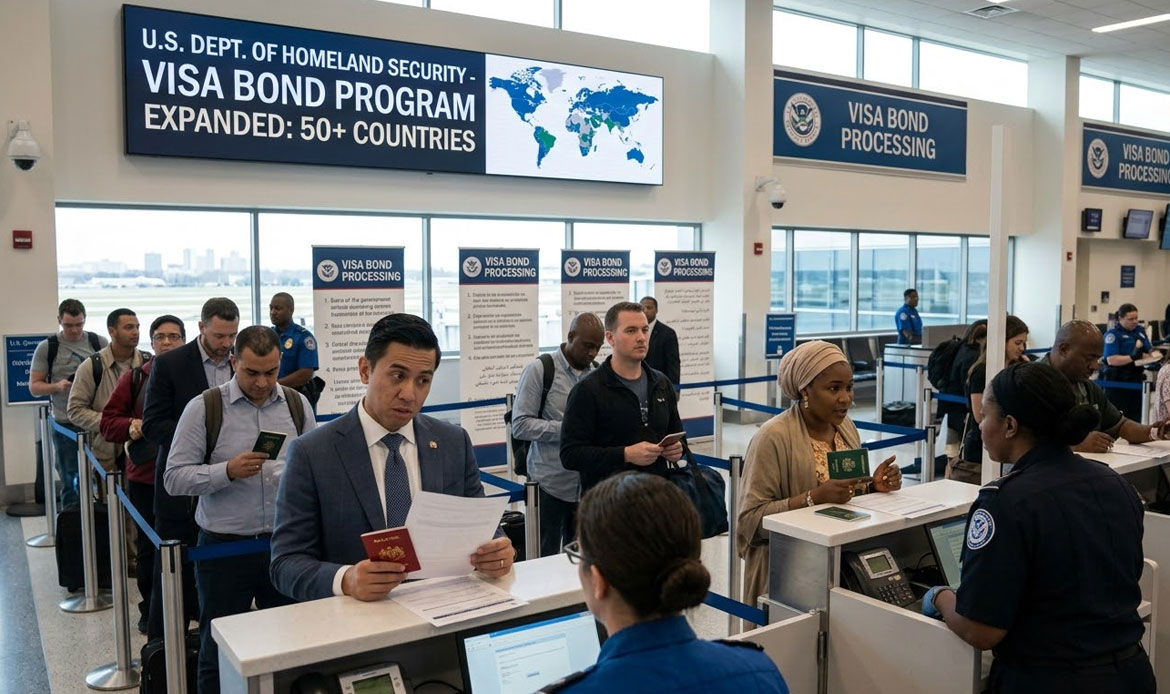
The United States has announced a significant expansion of its visa bond program, introducing financial requirements for short-term visitors from a broader range of nations. Effective April 2, 2026, nationals from 12 additional countries—bringing the total to 50—will be required to post a bond of up to $15,000 when applying for U.S. B1/B2 visas for business and tourism.
Introduced in August 2025 and administered by the U.S. Department of State, the program requires affected applicants to deposit a refundable bond prior to visa issuance. This bond is returned in full provided the individual complies with all visa conditions, including departing the United States within the permitted timeframe.
This expansion significantly broadens the program’s scope, transitioning it from a pilot initiative into an established tool of immigration oversight. The policy reflects the current U.S. administration’s ongoing efforts to tighten border controls and reduce visa overstay rates.
Newly Added Countries (April 2026)
Twelve additional countries have now been brought under the program: Cambodia, Ethiopia, Georgia, Grenada, Lesotho, Mauritius, Mongolia, Mozambique, Nicaragua, Papua New Guinea, Seychelles, and Tunisia
The inclusion of Grenada, a Caribbean jurisdiction with close U.S. ties, is notable. It is the only country in the region that offers a Citizenship by Investment (CBI) program while maintaining a special treaty with the U.S. that enables Grenadians to obtain E-2 Investor visas.
Countries added in August 2025
The expansion builds on an existing list of 38 countries already subject to visa bond requirements: Algeria, Angola, Antigua and Barbuda, Bangladesh, Benin, Bhutan, Botswana, Burundi, Cabo Verde, Central African Republic, Côte d’Ivoire, Cuba, Djibouti, Dominica, Fiji, Gabon, The Gambia, Guinea, Guinea-Bissau, Kyrgyzstan, Malawi, Mauritania, Namibia, Nepal, Nigeria, São Tomé and Príncipe, Senegal, Tajikistan, Tanzania, Togo, Tonga, Turkmenistan, Tuvalu, Uganda, Vanuatu, Venezuela, Zambia, Zimbabwe
Several of these jurisdictions—including Antigua and Barbuda, Dominica, São Tomé and Príncipe, and Vanuatu—have active CBI programs. As of April 2026, two other Caribbean nations that offer citizenship in exchange for qualified investment, Saint Kitts and Nevis and Saint Lucia, remain unaffected by the bond requirements.
Visa Bond Program Details
Under the program, applicants who are otherwise eligible for a B1/B2 visa may be required to post a bond of either $5,000, $10,000, or $15,000, with the exact amount determined by the consular officer at the time of the visa interview. The bond is therefore a conditional requirement tied to visa issuance, not a prerequisite for applying.
As part of the process, applicants must complete the Department of Homeland Security’s Form I-352 (Immigration Bond) and formally agree to the bond conditions through the U.S. Department of the Treasury’s secure payment platform, Pay.gov. This requirement applies irrespective of where the visa application is submitted.
Form I-352 and any associated payment must only be completed following explicit instructions from a consular officer. Applicants receive a direct payment link and are advised not to engage any third-party intermediaries or unofficial platforms. The U.S. government does not assume responsibility for funds transferred outside its official systems. It is also important to note that the posting of a bond does not guarantee visa issuance; any payments made without proper authorization are non-refundable.
As a condition of the bond, visa holders are required to enter and exit the United States exclusively through designated ports of entry, namely commercial airports, including U.S. preclearance locations. Entry or departure via charter flights, general aviation, land borders, or sea ports is not permitted under the bond framework and may result in denied entry or failure to properly record departure.
Compliance with bond conditions is monitored by the Department of Homeland Security and governed by the terms set out in Form I-352. The bond is automatically cancelled and refunded where the visa holder departs the United States within the authorized period of stay, does not travel before the visa expires, or is denied admission at the port of entry.
Conversely, potential breaches of bond conditions are referred to the U.S. Citizenship and Immigration Services (USCIS) for review. This may include cases where the individual overstays their authorized period, remains in the United States without departure, or seeks to adjust status from within the country, including through asylum claims. In such instances, the bond may be forfeited.
U.S. Department of State states that the measure is specifically designed to address high overstay rates among certain nationalities, and that financial accountability creates a strong incentive for compliance.
According to the official figures, the program has already demonstrated measurable success: approximately 97% of travellers subject to visa bonds have complied with their visa terms and returned home on time. In total, nearly 1,000 visas have been issued under the program to date. The policy could save U.S. taxpayers up to $800 million annually in enforcement and deportation costs. The official statement also noted that removing an individual who overstays a visa can cost, on average, over $18,000—exceeding the bond amount itself.
Broader Context
The expansion is part of a shift toward stricter immigration enforcement. The new U.S. administration has implemented a series of measures, including:
- Expanded deportation efforts
- Pausing immigration visas and asylum claims for certain nationals
- Increased scrutiny of visa applicants, including social media screening
- Revocation of visas and residency permits in certain cases
- The reintroduction of travel restrictions
These policies have drawn criticism from human rights organizations, which argue that such measures may disproportionately affect nationals of developing countries and raise concerns regarding due process and equal treatment.
At the same time, U.S. officials and supporters of the policy contend that such steps are necessary to safeguard national security and maintain the integrity of the immigration system.
From a broader perspective, the expansion of the visa bond program reflects an evolving global mobility landscape, where access to major destinations is increasingly shaped by risk profiling, compliance history, and economic assurances.
For legitimate travelers—particularly business professionals, investors, and families with established international ties—the bond may function more as a procedural formality than a barrier. However, for others, the upfront financial commitment could influence travel decisions or delay plans.
Importantly, the bond is not a fee but a refundable guarantee, contingent on compliance with visa conditions.
* * *
Disclaimer: This article is provided for general informational purposes only and does not constitute legal, tax, or immigration advice. Policies and procedures described herein are subject to change and may vary depending on individual circumstances. Readers are advised to seek professional guidance before making any decisions related to visas, immigration, or international travel. Bayat Group accepts no responsibility for actions taken based on the information contained in this publication.