
By Sam Bayat Esq.
(This article was originally published on the author’s LinkedIn page on May 27, 2026)
n investment migration, political risk is something we typically associate with emerging markets or unstable jurisdictions. We model it, hedge against it, and advise families accordingly. What many did not expect was to encounter a version of that uncertainty inside the United States — a country long regarded as one of the world’s most predictable destinations for talent and capital.
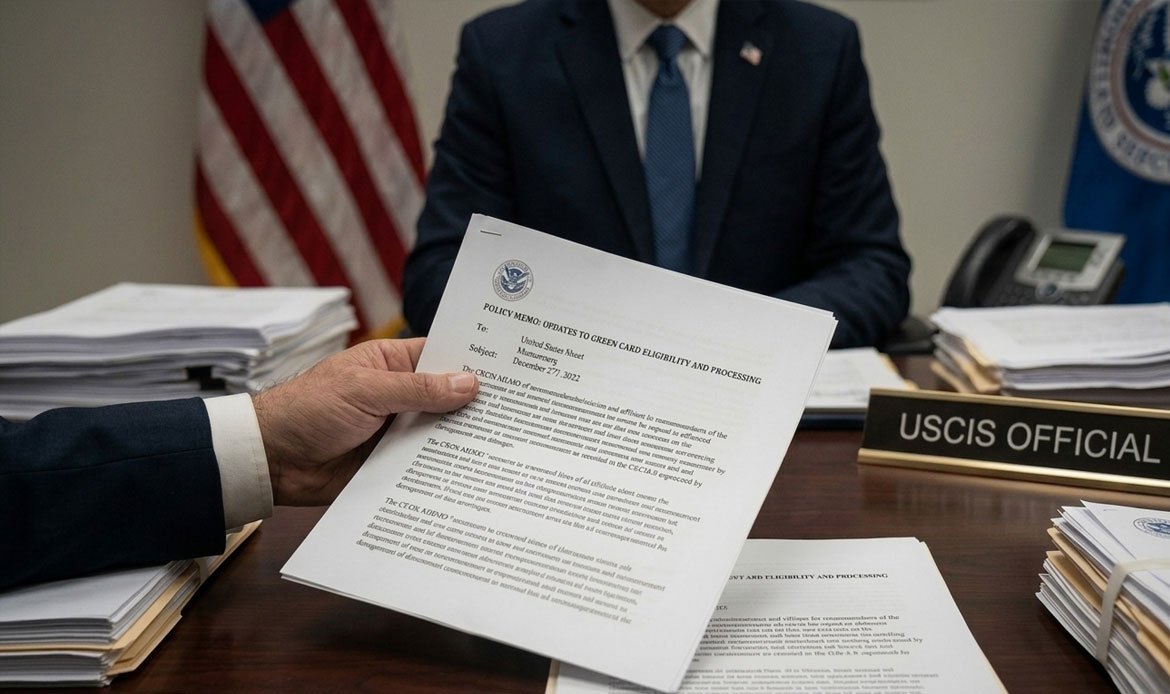
On May 22, 2026, U.S. Citizenship and Immigration Services (USCIS) issued Policy Memorandum PM-602-0199 — a document that, in the span of a few paragraphs, upended the immigration plans of hundreds of thousands of people legally living in the United States.
The headlines were alarming. The reality is more nuanced. As my colleague, immigration lawyer Mona Shah, stated in her article “A Gift to the Competition”:
“When a government tells applicants that approval is now an act of grace rather than the ordinary result of eligibility, a rational applicant stops asking how to win and starts asking whether the contest is worth entering.” — Mona Shah, Esq.
What the Memo Actually Says
The memo reframes Adjustment of Status (AOS) — the process by which a foreign national already inside the United States converts their temporary visa into a green card — as “extraordinary relief” rather than a standard legal pathway. In plain terms: if you are in the U.S. on a student visa, a work visa, or a tourist visa, and you want a green card, USCIS now expects you to go home and apply from abroad through consular processing at a U.S. embassy. In-country adjustment will be granted only in what the agency calls “extraordinary circumstances.”
The underlying statute, Section 245 of the Immigration and Nationality Act, has not changed. What changed is the discretionary lens through which officers evaluate applications. That distinction matters enormously.
Three Things Most People Are Getting Wrong
Before we discuss what this memo means for investors, let me address three widespread misconceptions I have seen repeated in the press and in public commentary.
First: this does not eliminate Adjustment of Status. The memo does not abolish in-country green card applications. It makes them more difficult to obtain and subjects them to heightened discretion. AOS remains a statutory pathway. However, that pathway now comes with a significantly heavier burden of proof.
Second: this is not only about undocumented people. This is perhaps the most dangerous misreading of the memo. The policy targets legal visa holders — students on F-1 visas, skilled workers on H-1B visas, investors on E-2 visas — people who followed every rule, paid every fee, and built lives in the United States through legitimate channels. It is legal immigrants who are likely to bear the brunt of this policy.
Third: The U.S. EB-5 investor visa practitioners are confident that a statutory carve-out shields their investors from this policy. As Mona Shah explains:
“INA 245(n) was added to the EB-5 Reform and Integrity Act of 2022 (also known as RIA). The amendment did two things to Section 245: it inserted exemption language, and it added a new subsection (‘N’) providing that if approval of a petition would make a visa immediately available to the beneficiary, the adjustment application would be considered properly filed. Congress created this provision specifically for EB-5 concurrent filing. A policy memo cannot override this provision.” — Mona Shah, Esq.
The Human Costs
Consider scenarios that play out thousands of times each year. A young engineer arrives from abroad on an F-1 student visa, graduates from an American university, secures employment with a U.S. company, and seeks to adjust status. Or consider an EB-5 investor — investing $800,000 or more in a U.S. business, creating American jobs, and contributing to the economy in precisely the manner the program was designed to encourage. Under the concurrent filing provisions introduced by the EB-5 Reform and Integrity Act of 2022, that investor could simultaneously file an I-485 adjustment application and obtain work authorization within months, without leaving the country.
Under this new memo, that same investor may instead be expected to return to their home country to pursue consular processing. At some U.S. embassies, interview backlogs already extend beyond a year. At others, there is no fully functional diplomatic post at all.
But the trap runs deeper. For applicants who have accrued even a brief period of unlawful presence — often through status complications, gaps in authorization, or denied petitions — departing the United States may trigger three- or ten-year reentry bars. The very act of complying with the memo’s implied directive could make someone permanently ineligible for the green card they left to pursue. These are not hypotheticals. They are mechanical flaws that immigration attorneys have long warned about, and they will ensnare real families.
What This Means for the EB-5 Investor Specifically
For the investment migration community, the memo’s timing is particularly fraught. The EB-5 program’s regional center authorization expires in September 2027. The RIA’s grandfathering provisions protect petitions filed before September 2026 — a window that is closing. And now, the AOS pathway that made EB-5 so attractive to investors already residing in the U.S. has been placed under a cloud of uncertainty.
The investors most at risk fall into several profiles. Those already in the U.S. on F-1 visas who pursued EB-5 precisely because it offered a lawful path to permanence without interrupting their careers and education face immediate disruption. E-2 treaty investors who planned to transition to EB-5 as their businesses matured are now caught mid-journey. And EB-5 investors who already hold conditional green cards face a more insidious uncertainty.
Investors cannot plan in uncertainty. They must see a credible program that exists and operates — not one whose pathways are being systematically narrowed.
The Litigation Is Coming and It Will Be Costly
Several law firms have already signaled that litigation is likely. The memo creates grounds for legal challenge on multiple fronts: its apparent retroactive application to pending cases without a grandfather clause, its vague “extraordinary circumstances” standard, and the procedural question of whether a policy memo can effectively rewrite a congressionally established pathway without notice-and-comment rulemaking.
But litigation is cold comfort for the investor who has already committed $800,000 or $1.05 million, uprooted their family, and enrolled their children in American schools. Courts move slowly. Policies move quickly. The gap between the two is where lives are disrupted.
This memo is a significant signal, and it must be read in the context of a broader pattern. The U.S. is becoming more selective, less accessible, and bureaucratically more restrictive toward legal immigration, even toward the category of investors it has historically courted most aggressively. Whether this represents a strategic shift or merely an administrative footnote remains to be seen.
My advice to clients is threefold.
Act with urgency on pending filings. If you have a concurrent filing in process, document your “economic benefit” case as thoroughly as possible. Work with specialized counsel to proactively build the evidentiary record that USCIS officers will now scrutinize. Do not assume that past practice will be honored.
Do not wait for legal clarity before diversifying. The instinct to wait and see is understandable but dangerous in this environment. Litigation may soften or reverse this policy, but that process will take time. Your immigration strategy cannot afford to depend on a legal outcome you cannot control.
Build a global mobility architecture, not a single-country plan. This is the lesson that sophisticated investors and families are learning, sometimes painfully, from this episode. No single country’s program — not the U.S., not Portugal, not Malta, the list is long — is immune to political change. What protects a family is not a single visa but a portfolio of options: residency in one jurisdiction, children’s education in another, tax residency thoughtfully structured in another, alternative citizenship as a backstop, and banking and business operations distributed across stable jurisdictions. The goal is sovereignty — the ability to live, work, invest, and protect your family regardless of what any one government decides on any given Friday afternoon.
The clients who will navigate this moment most successfully are not those who held on to their U.S.-only strategy the longest. They are those who treated their global mobility as a layered architecture, built over time, adjusted as the landscape changed. That architecture is becoming a practical necessity for any globally mobile family in the current environment.
A Closing Thought
The United States built its immigration system, including the EB-5 program, on a proposition: that foreign capital, talent, and entrepreneurship were assets worth welcoming. That proposition has not been formally abandoned. But when a policy memo can place hundreds of thousands of legal residents into legal limbo overnight, with no grandfather clause for pending cases and no clear definition of who qualifies for relief, the practical meaning of that proposition becomes difficult to defend.
This memo will affect real people in profound ways. The student who built a life. The investor who created American jobs. The family that made irreversible decisions based on the rules as they understood them. Those people deserve clarity, and the absence of it, from an agency that had ample opportunity to provide it, is not just a technical oversight but a choice.
The investment migration industry must respond to that choice with clear eyes and honest counsel. The U.S. remains a compelling destination for the right investor in the right circumstances. But the days of treating it as the only destination, or as immune from political and administrative volatility, may be coming to an end.
Special thanks to Mona Shah, Esq. for her contribution.
Disclaimer: The information contained in this article reflects publicly available sources and professional commentary at the time of publication. It is provided for informational and educational purposes only and should not be interpreted as legal, tax, or immigration advice. As every case is unique, readers are encouraged to consult qualified professionals regarding their specific circumstances.