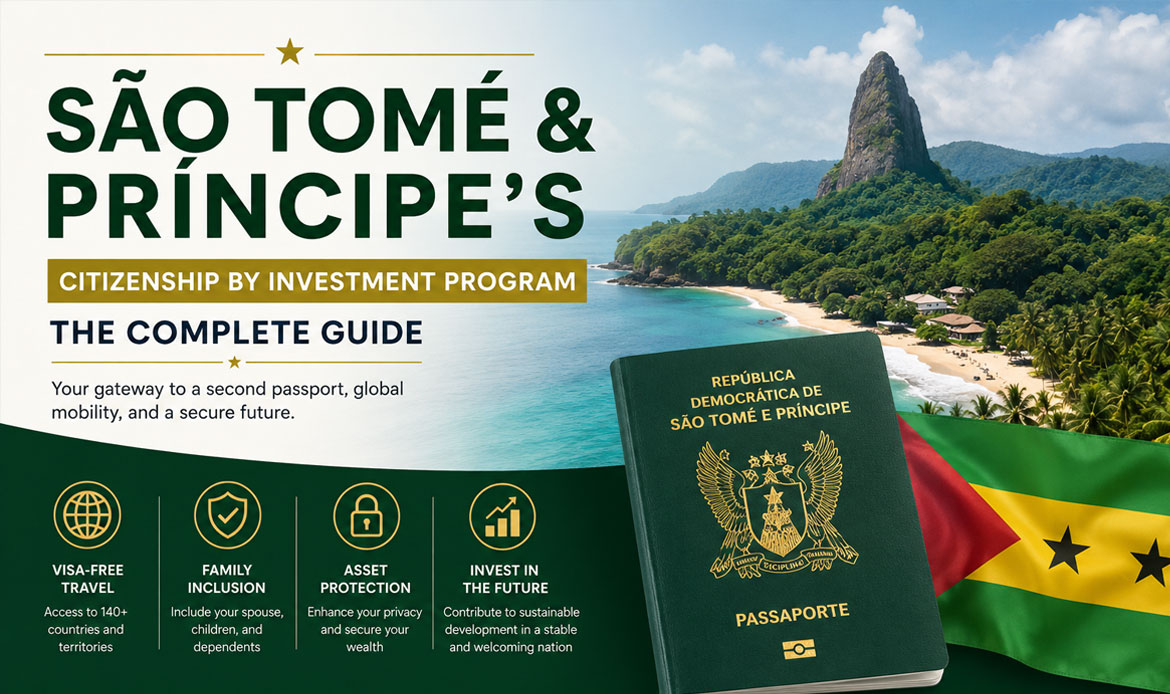
São Tomé & Príncipe has been on the citizenship by investment map for less than a year, but it has already become one of the more talked-about entries in the market, mostly on the strength of a single number. At US$90,000, it undercuts Vanuatu, undercuts every Caribbean program still standing, and does so while offering a fully remote, no-residency application. That combination is rare enough that it invites a natural question: what exactly are you getting for that price, and how solid is the legal ground it sits on?
This guide walks through the program as it currently stands: the law behind it, the actual costs, who qualifies, how the process works in practice, and what the first cohort of approvals tells us now that the program has moved past the announcement stage and into results.
The Legal Basis
São Tomé & Príncipe’s citizenship by investment framework rests on two pieces of legislation. Nationality Law No. 07/2022 provides the underlying statutory basis for granting citizenship through investment or donation. Decree-Law No. 07/2025; formally titled the “Regulamentação da Nacionalidade por Investimento ou Doação“, sets out how that provision actually works: eligibility, procedure, fees, and oversight. It was published in the country’s official gazette, the Diário da República, on August 1, 2025, and that date marks the program’s formal launch. Applications began being accepted the following month.
Administration sits with the Citizenship by Investment Unit (CIU), a body created specifically for this purpose. Its structure is a little unusual for a program of this kind: rather than being run out of São Tomé & Príncipe itself, the CIU’s operational office is based in Dubai, under a public–private arrangement. A Dubai-based firm holds a ten-year exclusive contract to manage the unit’s technical operations and handle international promotion of the program, working alongside a review committee chaired by São Tomé & Príncipe’s Public Ministry. Even after a passport is issued, the Attorney General’s office retains the right to challenge a citizenship grant for up to six months: a due diligence backstop worth knowing about, since it means “approved” isn’t quite the same as “beyond review” in the first half-year.
The Investment Route
Unlike programs that offer a choice between real estate, government bonds, or a donation, São Tomé & Príncipe runs a single route: a non-refundable contribution to the National Transformation Fund (Fundo Nacional de Transformação). The fund is earmarked for renewable energy, healthcare, education, and infrastructure projects across the archipelago. There’s no investment option to speak of; you’re not buying anything you can later sell or recoup. It’s structured and should be understood as a non-refundable donation.
One design feature is genuinely investor-friendly: the program runs on an approval-first basis. You go through due diligence and receive what the CIU calls “approval in principle” before any money changes hands. Applicants need to cover a non-refundable submission/registration fee of US$5,000 per application before proceeding with the qualified contribution payment. Only once that approval is granted, applicants need to make the contribution and pay the remaining fees. That sequencing matters: it means an applicant who fails due diligence hasn’t already paid US$90,000 to find that out.
Who Qualifies?
Eligibility is broad by design. The program is open to applicants of any nationality except North Korea, and there’s no minimum education, business experience, language ability, or interview requirement to clear. The core criteria are age (18 or older for the main applicant), a clean criminal record, and passing the government’s due diligence and source-of-funds checks.
Family inclusion is generous, and it’s one of the features distinguishing the program from others. Main applicant can include:
- A spouse or de facto/unmarried partner
- Children up to 30 years old, provided they’re financially dependent
- Parents aged 55 and above, provided they’re financially dependent
The program also allows stateless individuals to apply, and this is a provision most CBI programs don’t bother to make.
Applicants previously declined by another citizenship program aren’t automatically excluded either; São Tomé & Príncipe’s due diligence process considers each case on its own record rather than treating a prior rejection elsewhere as disqualifying in itself. Given how differently due diligence standards are applied across the industry, that’s a reasonable approach in principle, though it also means the depth of the country’s own screening is what actually determines the program’s credibility over time.
How the Process Works
The application runs through five broad stages: an initial eligibility consultation, document and KYC preparation (this is where source-of-funds evidence gets assembled and certified), formal submission to the CIU, government due diligence and review, and finally, after approval in principle and payment, citizenship grant and passport issuance. The whole process is designed to be completed remotely; there’s no requirement to travel to the country at any point, before or after citizenship is granted.
Timelines are where marketing language and real-world outcomes have diverged the most, so it’s worth separating the two. Early promotional material pointed to processing in as little as six weeks. Most agent sites now quote a range of roughly six to ten weeks for CIU processing, with the caveat that document readiness and due diligence complexity can push things out further. What we actually have to go on, though, is outcome data from the program’s first cohort: between September 2025 and January 2026, the CIU reportedly received around 98 applications and approved 27 of them, with the first passports issued in January 2026. Average processing time for that batch came out to roughly 2.5 months from submission to passport delivery, with the fastest case completed in about a month.
One detail worth knowing if you’re planning around it: the decree also allows cryptocurrency to be used as evidence of the source of funds, provided the actual contribution payment itself is made in US dollars. That’s a meaningful accommodation for applicants whose wealth sits substantially in digital assets, and it’s not something every CBI program is willing to work with.
What the First Cohort Tells Us
Reported applicant data from that same September 2025–January 2026 window shows a fairly concentrated demand base: roughly 80% of applications came from just five countries — Germany, India, Russia, China, and Nigeria. That’s a mix worth noting, since it spans both established outbound CBI markets (Nigeria, China) and jurisdictions where affordability and speed appear to be doing most of the work in the decision (Germany, India). A 27-out-of-98 approval rate through the first several months also suggests the CIU’s due diligence isn’t purely a formality, though it’s still too early, and the sample size too small, to draw firm conclusions about where the program’s real screening bar sits.
Benefits, Fairly Stated
Citizenship granted under the program is permanent and passes to future generations by descent. There’s no requirement to renounce an existing nationality, and dual citizenship is fully permitted.
The tax pitch requires a bit of unpacking because it’s often presented as more novel than it is. São Tomé & Príncipe does not tax foreign-sourced income for non-resident citizens, but that’s a function of tax residency rules, not of holding the passport itself. You only become the country’s tax resident if you spend 183 days or more there in a given year, which is a fairly standard residency threshold used by many jurisdictions. In other words, the “zero tax on world income” line applies to almost anyone who doesn’t actually live there, citizenship or not; it’s worth understanding as a feature of staying non-resident, not a unique benefit conjured up by this specific program.
Visa-free access is the other figure that needs a caveat. Depending on which agent’s website you read, the passport is credited with visa-free or visa-on-arrival access to anywhere from the mid-50s to the low 90s in terms of country count. The honest answer is that the exact number moves as bilateral arrangements shift, and readers who want a reliable figure should check a live passport index rather than take any single agent’s number as fixed. What’s more durable is São Tomé & Príncipe’s membership in the Community of Portuguese Language Countries (CPLP), which gives citizens simplified visa processing and, in Portugal’s case, the ability to enter without a prior visa and apply for residence from inside the country. It’s a genuine practical benefit for anyone with an eye on eventual access to Portugal or the broader Lusophone world, including Brazil, Angola, and Mozambique.
On the administrative side, there’s no interview, no language or civics test, and no physical presence requirement at any stage. Similar features are increasingly rare as other programs, including several in the Eastern Caribbean, move toward mandatory residency days and biometric interviews.
How It Stacks Up
The comparison that gets made most often is with Vanuatu and Nauru, and it’s a fair one: Vanuatu’s minimum sits at US$130,000 for a single applicant against São Tomé & Príncipe’s US$90,000, though Vanuatu’s program has a longer track record and a faster average processing time. As per Nauru, it also offers a similar threshold of US$90,000 and fairly competes with it. Against the Caribbean’s five CBI jurisdictions (St. Kitts & Nevis, Dominica, Grenada, St. Lucia, and Antigua & Barbuda) all of which now sit at or above a US$200,000 minimum standard under the ECCIRA framework, São Tomé & Príncipe’s pricing puts it in a different bracket entirely. What it doesn’t yet offer is the visa-free depth of the strongest Caribbean passports or their decades of operating history. For applicants prioritizing cost and speed over passport strength or program maturity, that trade-off is the one to weigh.
About Bayat Group
Bayat Group is the officially authorized agent for the São Tomé & Príncipe Citizenship by Investment Program. Our team manages the full process on behalf of applicants: eligibility assessment, document preparation, source-of-funds certification, submission to the Citizenship by Investment Unit, and coordination through to passport delivery. With decades of experience across citizenship and residency programs worldwide, we work directly with government channels to ensure applications are handled correctly and in full compliance with the program’s requirements.
Disclaimer: This article is provided for general informational and educational purposes only and does not constitute legal, tax, financial, or investment advice. Citizenship by investment regulations, fees, and procedures are subject to change, and figures reported by third parties (including processing times, application volumes, and visa-free access counts) may vary in accuracy. Prospective applicants should verify current program details directly with Bayat Group as the officially authorised agent before making any decisions.