
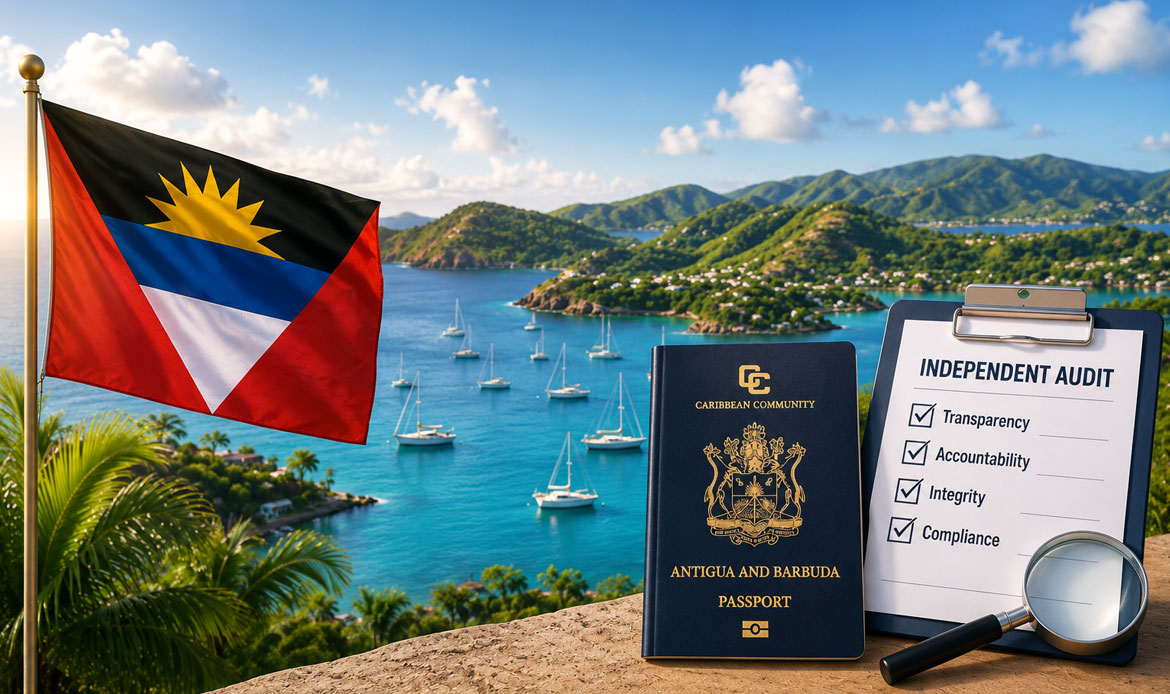
Five days used to be enough. Under amendments now before Antigua and Barbuda’s Parliament, new citizens will need to spend 30 days in the country, and the unit that processes citizenship by investment (CBI) applications will, for the first time, answer to independent auditors.
Prime Minister Gaston Browne presented the Citizenship by Investment (Amendment) Bill 2026 in Parliament in mid-July. The bill raises the post-citizenship residency requirement from five days to 30, applying to successful applicants and their dependents. It also subjects the Citizenship by Investment Unit (CIU) to annual independent financial and biennial operational audits conducted to internationally accepted standards. The CIU will also be required to report every six months to the Eastern Caribbean Citizenship by Investment Regulatory Authority (ECCIRA), the regional regulator that the five Eastern Caribbean CBI states agreed to establish in September 2025, expected to begin operations later this year (once Saint Lucia accomplishes the ratification; Antigua and Barbuda, Dominica, Grenada and Saint Kitts and Nevis have already ratified it), while continuing to report to Parliament.
So far, the bill has been only tabled, not passed. Until it clears Parliament, the amendments are not law. That said, Browne told legislators the 30-day requirement has already been applied administratively, meaning the bill largely formalizes existing practice and removes any inconsistency between domestic law and the ECCIRA agreement.
The 30 days are cumulative over the first five years of citizenship, not an annual obligation. A family that spends six days a year on the islands, or a single month once in five years, satisfies the requirement. And since the clock starts only after citizenship is granted and passports are issued, the travel itself is straightforward. For most families this is manageable. It is not, however, trivial: industry stakeholders note that for a family of four traveling from Asia or the Gulf, flights alone can run into serious money, and a month away from a business is a real cost.
The Deadline Behind the Housekeeping
Officially, the bill is regional housekeeping, aligned with the ECCIRA framework that all five Eastern Caribbean nations with CBI programs signed last September. That account is credible on its own terms: the 30-day rule and harmonized oversight were agreed among the five states long before this summer, and observers who have followed the regional reform process say these amendments were coming regardless.
But the timing is impossible to ignore, because the European Union (EU) has spent the past seven months turning up the pressure.
In December 2025, the European Commission, the EU’s executive body, which controls access to the Schengen visa-waiver list, published its eighth Visa Suspension Mechanism report and took a position it had never stated so bluntly: operating a citizenship by investment program is, “in itself,” grounds for suspending a country’s visa-free access to the Schengen area. Not weak vetting. Not missing “genuine links.” The mere existence of the program. The report named all five Eastern Caribbean CBI jurisdictions and recommended they tighten vetting “pending the discontinuation” of their schemes. That language treats reform as an interim measure and closure as the destination. The revised suspension mechanism entered into force on December 30, 2025.
Then, on June 25, 2026, the EU Commissioner for Internal Affairs and Migration wrote to all five governments demanding a phase-out of their programs by June 1, 2028, and set a 24-month transition window. There is no soft way to describe this: the EU wants Caribbean CBI programs to end, and visa-free travel to Europe is the leverage.
The region’s answer came on July 10, when the five heads of government met in Roseau, Dominica, and agreed to send a high-level mission to Brussels with a unified position. Read closely, their joint statement is a negotiating document. It never mentions the 2028 deadline, never refuses anything, and reserves its firmest language for the terms of “any transition”, which, the leaders insist, must come with a comprehensive framework of replacement development financing. These programs fund climate resilience, disaster recovery, and infrastructure across small island states; no government is prepared to walk away from that revenue without a substitute. The statement contests the price of a transition, not the premise of one. Antigua and Barbuda’s bill landed in Parliament one week later.
Where Reform Actually Has to Happen
Whether the Commission’s next Visa Suspension Mechanism report, due in December 2026, treats these amendments as progress depends on what Europe is actually measuring, and here, the honest analysis cuts against the industry’s reflexes.
For over a decade, the sector’s answer to every scandal has been the same: enhance due diligence on the applicant. Yet the programs’ best-documented failures were rarely applicant failures. They happened where a citizenship decision could be swayed by access to the right official rather than fixed criteria applied by a body with no stake in the outcome. That is a governance problem, and no amount of additional applicant paperwork fixes it. The Commission’s own framing points the same way: its objection targets the structure of these programs: who controls the decision, and whether that person answers to anyone; not the background check of any individual applicant.
Seen through that lens, the audit provisions in Antigua’s bill may matter more than the residency headline. Thirty days on the island demonstrate a citizen’s connection to the country; independent financial and operational audits demonstrate that the program itself runs on rules rather than discretion. That is the kind of reform with a chance of changing the conversation with Europe, provided the oversight is genuinely independent, not an extension of the governments it is meant to police.
Investment migration industry opinion splits on what the 24-month window really is. Some observers read it as an invitation to negotiate: if the EU wanted to suspend visa-free access today, the mechanism already exists. They argue that pre-travel screening systems like the European Travel Information and Authorisation System (ETIAS) could eventually give Europe the risk-management layer it needs without ending the programs. Others see the objection as fundamentally political rather than technical, and doubt any reform will change the calculus.
For investors, the practical conclusions are clearer than the politics. Caribbean citizenship remains available, and applications continue to be processed under existing rules. But the era of zero-presence citizenship is closing across the region; requirements are converging under ECCIRA, and the jurisdictions most likely to preserve their standing and their visa-free access will be those that can prove independent governance, not just thicker applicant files. In a market where the rules are being renegotiated between the Caribbean capitals and Brussels, predictability has become the scarcest asset of all. Planning around what a program requires today is necessary; structuring for what it may require in two years is what separates a durable second citizenship strategy from a bet.
Disclaimer: This article is provided for general informational and educational purposes only and does not constitute legal, financial, or investment advice. The legislative and regulatory developments described are ongoing and subject to change, including the Citizenship by Investment (Amendment) Bill 2026, which had not been enacted at the time of writing. Readers should consult a qualified immigration advisor before making any decisions based on this content.